Crowdsourcing AI Expertise
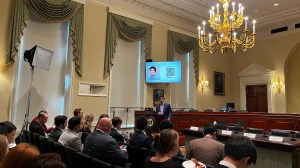
Earlier in the spring of 2024 I had the opportunity to become a member an artificial intelligence (AI) legislative policy sprint with the Federation of American Scientists (FAS). It literally was a sprint as we created all the briefs in about eight weeks. This crowdsourcing of expertise by FAS, as it was described by Daniel Correa, CEO of FAS, was an incredible undertaking on their part. This was truly a bipartisan labor of collaboration bringing together those with experience using AI to create the top ideas for legislation and policy related to AI.
At the time that the FAS put out the call for proposals for the policy sprint I was taking a course in AI in the Saïd Business School at the University of Oxford. I was learning so much and was realizing how far we were behind in the United States in education in terms of utilizing AI for considering the all important questions of how and what students learn. In a project for my Oxford course I wrote:
“First, teaching about artificial intelligence (AI) and teaching with AI are two very different things. In education we are going to have to do both; facilitating learning about the ethical use of AI and using AI in real world/work-based learning, so students understand how to use AI in careers. Therefore, one of the main obstacles that education faces is the need for education to evolve in the face of so many new technological developments making use of AI. Our policies will need to reflect the capabilities AI affords us. Educators must be trained in AI in programs very much like this one I am in now. Skill acquisition will need to be paramount to student seat time. Practicing, memorization, and repetition in many subjects is becoming irrelevant due to AI. AI allows us to shift memorization to understanding. Many are predicting this change in education to take two to six years. In education I believe societal acceptance is the biggest factor determining obstacles and adoption. Many might consider AI a technical challenge, which I recognize there are questions of technological progress, but I believe regulation (and who owns that regulation), economic conditions, plus the societal factor make this, instead, an adaptive challenge.”
Yesterday it was fascinating to listen to my colleagues’ ideas and views on AI in other sectors, including healthcare. One theme that came out throughout the day was that no matter the sector we need proactive prescriptions, not random knee-jerk reactions. This includes being responsive to new sources of risk. In other words, we need to catch threats before they happen. We also need to identify threats before they become public.
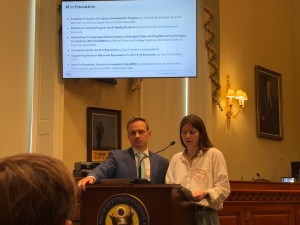
In my sector of education the themes of there not being enough data and the lack of training or guidance for teachers to be successful using and facilitating student use of AI emerged. One thing we need to do is leverage and mine the data we have. One thing is clear; we must be vigilant in helping educators understand AI and how to teach about AI as well as using AI to facilitate learning. I loved Zarek Drozda‘s comment when he said, “Education is a vaccine misinformation.” We must not miss the opportunity to educate our children for dealing with and using AI.
Click on A National Center for AI in Education to read my proposal. You can also click on New Legislative Proposals to Deploy Artificial Intelligence Strategically to see all the FAS Policy Sprint proposals.
Those proposals are broken into four categories:
- AI Innovation, Research and Development, and Entrepreneurship
- AI Trust, Safety, and Privacy
- AI in Education
- AI in Healthcare
I applaud the Federation of American Scientists for doing this innovative crowdsourcing of expertise to bring together great minds for creating policy ideas related to artificial intelligence. It was such an honor to be on the journey with everyone.
 Byron's Babbles
leave a comment