Oh The Stories We Told!

Last night I had the opportunity to ponder the power of stories and sub-stories and the learning that occurs from them for young and old alike. I got into Washington D.C. last night for a board meeting and had the opportunity to go to one of my favorite restaurants with some friends. We went to Old Ebbitt Grill. Every year when I brought students here for National FFA’s Washington Leadership Conference, of which I always brought my son, Heath, from when he was six months old on up, we would eat at Old Ebbitt one evening. In fact last night I sent my son a picture of one of the bars in the restaurant with the question “Do you know where I am?” He immediately texted back, “The bar/restaurant that Teddy [Theodore Roosevelt] always went to right next to the White House.” He was spot on! We had sat in Old Ebbitt and talked about the President’s who had been there. In fact, on Old Ebbitt’s website it says, “…Presidents Ulysses S. Grant, Andrew Johnson, Grover Cleveland, Theodore Roosevelt and Warren Harding supposedly refreshed themselves at its stand-around bar.” My son and I used to sit and imagine the conversations based on what was going on in the country at the time. Those were some very real history, government, and civics lessons. Oh the conversations we had.
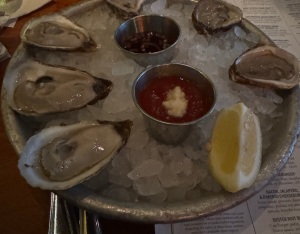
From a young boy on, my son has loved oysters. Old Ebbitt is known for their varied selection of fresh oysters (see photo for last evening’s list). Last night for my friends I modeled what Heath and I would do when picking oysters – we looked up where each of the oysters came from. Some of the places my friends had been to. Oh the stories that were told. In the end we tried four on the list based on places we had been. Again, oh the stories we told!

That’s the point of this post – the power and learning in the story. During the conversation last night with clanking dishes, loud laughter, a group singing happy birthday, and probably for others my loud voice in the background, one of my friends asked me why I had become so obsessed with C. S. Lewis. As you know, I just returned from spending a week at The Kilns. I told them I believe C. S. Lewis explained it best when he said, “What draws people to be friends is they see the same truth. They share it.” This quote is from the book “The Four Loves”. Lewis was telling us that true friendship is built on a foundation of shared beliefs, values, and understanding of the world. When people are able to connect on a deeper level and see things the same way, it creates a strong bond that can withstand test of time. Even though Lewis died the year I was born and coincidentally the same day as John F. Kennedy was assassinated, I feel a bond because of Lewis’s writing, storytelling and beliefs.
I was telling them that I am working through all the Chronicles of Narnia books right now in publication order and they are causing me to do a great deal of deep thinking and reflection. One of my friends piped up and said, “But those are children’s fairy tales.” Another friend yelled, “Well look who we’re talking to.” Touché! Seriously though, C. S. Lewis was the master at the skill of sub-creation. More about sub-creation in a minute. He created the fantastical world of Narnia, complete with its own mythology and history, which has captured the imaginations of readers for generations. Lewis’s ability to craft a rich and immersive fictional universe is a testament to his talent as a writer and his understanding of the power of myth and storytelling.
“Sub-creation” is a term coined by J.R.R. Tolkien, one of Lewis’s friends and member of the Inklings, to describe the act of creating fictional worlds or stories within a larger, pre-existing world. In Tolkien’s view, sub-creation is a form of artistic expression that allows individuals to tap into their creativity and imagination to produce new works that are inspired by or connected to existing mythologies or narratives. By engaging in sub-creation, artists and writers can contribute to the richness and depth of a fictional universe while also exploring themes and ideas that resonate with their own experiences and beliefs. It is a powerful form of creative expression that allows for endless possibilities and interpretations.
I believe this is why I have been so drawn to fictional work the last several years. It allows me to expand my thought beyond our preexisting narrow world. Lewis didn’t tell or right a story that didn’t draw us in to be a part of his world, whether fantastical, real, or visionary. What stories do you need to tell?
 Byron's Babbles
leave a comment