Never High Never Low

Prior to the Detroit Lions vs. Dallas Cowboys football game last night (Dallas sneaked past Detroit 20-19) I heard an interview with Detroit Lions Head Coach, Dan Campbell. In the interview, Campbell said of Lions quarterback, Jared Goff, “He’s never high, he’s never low. He’s always the same.” Campbell made this comment after being asked what kind of leader Goff was. When he said this it gave me pause because the leader that remains consistent in their demeanor and behavior regardless of the circumstances or challenges they face truly is a treasure.
This trait is the leader that remains calm, composed, and rational, even during times of success or failure. They do not let their emotions dictate their actions and are able to maintain a steady and level-headed approach in their decision-making. This consistency can often inspire others and instill confidence in the leader’s ability to lead effectively.
Not Everyone Has The Same Educational Needs

Right now we are doing a lot of talking about how college is not for every student. Or, going to college isn’t worth the expense. I worry about shallow statements like these. What I believe we need to be contemplating is that not everyone has the same educational needs. In other words we need to consider that not everyone has the means for what we consider the traditional “coming of age” experience of attending a four-year university. Do I wish they did? Yes! And, I am doing lots of work toward this end. But for some, for lots of different reasons that is not possible.
Furthermore, even though I would love for everyone to have that “coming of age” experience appropriate to their individual needs, we must realize the college education is not the end-all-be-all. Recently, I heard someone say “I’ve got a degree but I’m not going to let it ruin my life.” What I believe the person was saying is
that despite having obtained a degree, the person does not want to let their education define or limit them. They recognize that a degree is only one aspect of their life and that they want to pursue personal happiness, fulfillment, and success beyond the boundaries of their academic achievements. This statement suggests a desire to maintain a balanced perspective on life and to prioritize personal growth and well-being over the pressures or expectations that may come with having a degree.
Let’s face it, the traditional college education was built for the elite. There are strides being made to change this, but we still have a ways to go. We must keep working at this because the college degree is still the best predictor of social and economic mobility. And I want that for every student. A postsecondary education is a multi-generational wealth builder. As we continue to shift to a knowledge and creativity era this creates tremendous opportunities for our young scholars. We need to be thinking about bite-size learning or stackable credentials.
All Fact And No Meaning

As a renowned writer and scholar known his works on theology and fantasy literature, C. S. Lewis was emphasizing the importance of finding meaning when he said, “His world is all fact and no meaning.” Lewis was likely referring to the idea that some individuals or societies may prioritize knowledge and facts without considering the deeper significance or purpose behind them. In other words, they focus solely on gathering information without reflecting on its implications or connecting it to a larger framework of understanding. This quote can serve as a reminder to not only seek knowledge but also to find meaning and purpose in what we learn and experience.

In The Weight of Glory, Lewis also explored the deeper aspects of life and the human experience. When he said, “He sees all the facts, but not the meaning,” he was likely discussing the idea that simply collecting information or facts does not necessarily lead to understanding or wisdom. From Lewis’ perspective, it is important to go beyond surface-level knowledge and strive to understand the meaning behind the facts. This could involve asking questions such as “Why is this information significant?” or “How does this fit into a larger framework of understanding?”
By considering the meaning behind the facts, we can gain a more comprehensive understanding of the world around us. This can help us make connections between different pieces of information and develop a deeper appreciation for the complexities of life.
Ultimately, Lewis’ thoughts here serve as a reminder to not just accumulate knowledge, but also find both the personal and societal meaning in the the associated context.
Two Heads Are Better Than One

I’ve never heard anyone describe C.S. Lewis as a teacher of leadership, but in the exhaustive study I am doing of him and all his writings I continually find nuggets that are quite genius and related to leadership in some way. Here is one such nugget I found this morning as I finished reading A Mind Awake: An Anthology of C. S. Lewis:
“People were no cleverer then than they are now; they made as many mistakes as we. But not the same mistakes. . . . Two heads are better than one, not because either is infallible, but because they are unlikely to go wrong in the same direction” (p. 290).
C. S. Lewis, reprinted from Introduction to St Athanasius’s The Incarnation of the Word of God in A Mind Awake
I believe we can break this statement down into two parts. Let’s first examine, “People were no cleverer then than they are now; they made as many mistakes as we. But not the same mistakes. . . .” When C.S. Lewis made this statement, he meant throughout history and across different time periods, humans have always possessed the same level of intelligence and made similar numbers of mistakes. However, the nature of these mistakes may differ. Lewis was highlighting the idea that while humans may make different types of mistakes in different eras, the fundamental capacity for error remains constant. This perspective suggests that we can learn from the mistakes of the past and strive to avoid repeating them in the present and future.
Now let’s examine the last part of the statement, “Two heads are than one, not because either is infallible, but because they are unlikely to wrong in the same direction.” Here, Lewis was emphasizing the value of collaboration and different perspectives. He believed that when multiple individuals come together to solve a problem or make a decision, their collective knowledge and diverse viewpoints can help to minimize errors and ensure a more balanced outcome. Rather than relying solely on one person’s judgment, having multiple perspectives can lead to a more comprehensive understanding and contribute to better decision-making overall.
Notice Lewis was promoting ‘collaboration’ long before it was a cool leadership buzz word. Of course, now we realize just how important collaboration is and how important relationships are to successful collaborations. I just blogged about that is Relationships Determine The Creative Outcome.
Seeing Through All Things Is Not Seeing At All

C.S. Lewis recognized that trying to understand or analyze everything at its most fundamental level can lead to a loss of meaning and depth. In A Mind Awake: An Anthology of C. S. Lewis he said, “It is no use trying to ‘see through’ first principles. If you see through everything, then everything is transparent. But a wholly transparent world is an invisible world. To ‘see through’ all things is the same as not to see” (p 270). Just imagine being able to see through everything. While I believe in being transparent from a leadership standpoint, I also recognize that we would go crazy trying to understand and know every detail about everything.
If everything is completely transparent and understood, then there is no mystery or wonder left in the world. To see through all things means to not truly see or appreciate them for what they are. For example, if we think of glass, it is really opaque. Glass exhibits colors beyond our vision and absorbs wavelengths that our brains cannot convert into an understandable image which makes it transparent to us. Thus, glass amazingly absorbs UV radiation, which we can’t see, and that is why you cannot get tanned or sunburned through it. It is important, in many respects, to recognize and respect the inherent complexity and beauty in the world, rather than trying to reduce everything to its basic elements.
Thoughts & Imagination
In my quest of studying C. S. Lewis and reading all that he has written, I am reading The Search For God right now. I love these compilations of his writings, speeches, and sermons because it provides the opportunity to re-read some material and hear new material. This is a great mix that causes deep reflection. Lewis spent a great deal of time addressing our conscious and rational minds versus our imagination. It is from the conscious mind that we predominantly operate each day. But, much of our behavior, attitudes, and decisions are influenced, if not ruled, by our imaginations. This is not a bad thing, and actually for those who fully embrace it, who we call artists, it is a great thing. Lewis argued and continually contemplated our need to balance out our bias toward rationalism and create space for the imagination. Or, at the very least recognize the role imagination plays in our thinking.

In The Search For God C.S. Lewis said, “What you think is one thing, what you imagine while you are thinking is another,” and I believe he was referring to the idea that our thoughts and imagination are not always aligned. While we may have conscious thoughts and beliefs about something, our imagination has the power to create different scenarios or possibilities that may diverge from our initial thoughts. This statement suggests that we should be aware of the distinction between our conscious thoughts and the imaginative possibilities that can arise during the thought process.
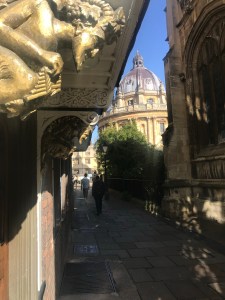
The example Lewis gave was how he imagined the University of Oxford before he had actually been there was different than what he actually saw. That wasn’t necessarily a bad thing, especially since he was there for academic reasons, not how the University. This made me think of all the times I have said things like, “This is not how I had imagined this” or “I’m not really sure what I thought this was going to be like, but this is not what I was imagining.” Has this ever happened to you? Our imagination is so powerful. It can work for us and can also work against us at times. Bottom line: we need to allow our minds to wander and wonder.
The Work You Never Dreamed Of
C. S. Lewis said, “Doubtless it is a rule in poetry that if you do your own work well, you will find you have done also work you never dreamed of” (p. 253) in A Mind Awake: An Anthology of C. S. Lewis. This comment caused me to consider the implications of doing our own work well in our professional lives beyond poetry.
I believe C.S. Lewis was suggesting that when we focus on doing our own work well, we may discover that we have also accomplished things beyond our original intentions or expectations. This idea can be applied to our everyday professional lives by emphasizing the importance of doing our best in our current tasks and responsibilities. By putting in the effort and striving for excellence, we may find that we not only meet our immediate goals but also uncover new opportunities, skills, or achievements that we didn’t anticipate. It’s about maintaining a strong work ethic and being open to the possibilities that may arise from our hard work and commitment. As my mom always said, “Do your best.” Boy, do I miss her.
Freedom, Wandering, & Finding A Path

In the The Storyteller: Expanded…Because There’s More To The Story, Dave Grohl said of his mother, “I like to say now that she disciplined me with freedom by allowing me to wander, to find my path, and ultimately find myself.” I believe he meant that his mother, who was a public school teacher, gave him the freedom to explore and make his own choices. Rather than imposing strict rules and limitations, she allowed him to venture and discover his own passions and interests. This approach helped him develop his own identity and find his true purpose in life.

This wandering and freedom had to be tough for his mom as it led to Grohl dropping out of school. But, as his mom said, “It’s not always the kid that fails at school sometimes it’s the school that fails the kid.” Grohl really didn’t explain the statement except in his own context of wanting to become an artist as a rock musician. I believe as a school teacher his mom was rightly referring to the idea that sometimes it’s not the child’s fault for struggling in school, but rather the educational system or environment that is not able to meet their needs or support their learning style. I believe, as Grohl does too, that it is important to recognize that each child is unique and may require different approaches to learning. Instead of blaming the child for not succeeding, it is necessary to evaluate and address the shortcomings of the school system to ensure that every student has an equal opportunity to thrive academically. This is why I am so excited to be a part of policymaking for Indiana’ school redesign. We need a system where every child’s uniqueness can be celebrated and developed. We cannot continue as we are right now, where the best choice some is to drop out of school, because the school cannot meet the student’s needs – as was the case for Grohl.
Relationships Determine The Creative Outcome

Another great statement in the book, The Storyteller: Expanded…Because There’s More To The Story, by Dave Grohl was, “I wholeheartedly believe that the relationships between people determine the outcome of any creative endeavor.” When you think about it, this is so true. Our interpersonal connections and dynamics among individuals involved in a creative project greatly influence its final result. He argued that collaboration, communication, understanding, and trust between team members are crucial for creating something impactful and successful.

Also being emphasized was the importance of fostering positive relationships and working together harmoniously to achieve a common goal. According to Grohl, it is not just about individual talent or skill, but how people interact and collaborate with each other that ultimately shapes the outcome of any creative endeavor. As I always say: “Relationships matter!”
Triple Power of Real-World Experiences, Representation, and Invitation in Student Learning

I was asked to write the November’s Monthly Thoughts for the National FFA Teacher Ambassador Monthly Newsletter. I loved being asked to do this. I chose to write about three students who inspired me during the National FFA Convention this year. This content is important enough that I wanted to share this inspiration with all my followers. There is an increasing recognition of the importance of providing students with real-world experiences, diverse role models, and inviting learning environments. The three students I am highlighting here reminded me of the immense power these elements hold in shaping young minds, fostering personal growth, and enhancing educational outcomes.

Real-World Experiences
Real-world experiences bridge the gap between theoretical knowledge and practical application.
By engaging in hands-on activities and solving real-world problems/issues, students develop
critical thinking skills, problem-solving abilities, and a deeper understanding of complex
concepts. Ava Oentrich, Junction City FFA, Kansas, did an incredible job articulating this to
administrators during our School Administrator Program.

Representation
The power of representation cannot be overstated. When students see teachers who look like
them and come from similar backgrounds, it fosters a sense of belonging and inspires them to
believe in their own potential. Diverse educators serve as powerful role models, breaking
stereotypes and encouraging students to pursue their dreams without limitations. During the
second day of the School Administrator Program Lauren Easter from Virginia shared the
importance of having teachers she could look at, learn from, and realize that she could be just
like them.

The Power of Invitation
Seventh grader and daughter of Ambra Tennery, Brinley Tennery, reminded me of the power of
the invitation when on the first day of convention she invited me to sit and have lunch with her.
You can read all about this experience in The Power Of The Invitation.
Why This Matters
The power of real-world experiences, representation, and an inviting educational environment cannot be underestimated. These factors ignite a passion for learning, enhance academic achievement, and contribute to the holistic development of students. As educators and society as a whole, it is crucial that we prioritize these elements to ensure every student has the opportunity to reach their full potential.
 Byron's Babbles
leave a comment