Discretion
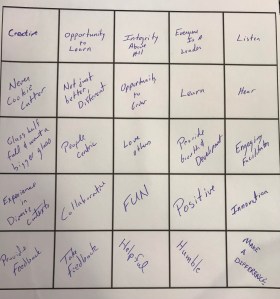
I did a Bingo card strengths/talents/values activity during a leadership development gathering this week with the great leaders I get to work with at Hamilton Heights School Corporation focused on building highly effective teams. The focus was on both being a great team member as well as being a great team leader. Filling out the Bingo card starts as an individual activity, but also has some time allowed for discussing getting to exactly the right words and helping each other find the right words. I always do this activity right along with the groups and my Bingo card is the featured photo of this post. This group was really into getting the right words to describe their strengths, talents, skills and values. This group’s discussion inspired me to think deeper about those traits as well.

It always seems that in the days after doing this activity I come across an intriguing word that I would maybe like to add. Today, while reading the incredible book The Body Scout by Lincoln Michel I read the line, “Do you know what the most important trait we look for in a great baseball scout? Discretion!” I have paraphrased a little here, but discretion is an interesting trait. Check out the definition:

I love the dual definition that discretion has. Discretion is something we should have as a great leader and team member. And, it is something we should give as a great leader. It is so important for us to use discretion when working with others. Great leaders are required to extensively exercise discretion to address the issues they face. Discretion must be used in the current context. Discretion is a behavior that involves using our core values. The sniff test I use is asking the question, “Is this my story to tell?” Guess what? Most of the time it is not. That helps me use discretion.
Additionally, as a leader whose mantra is “make it so” we must be ready to give discretion to those we serve. That also means we must have those we serve developed with the technical skills to effectively use that discretion. This really made me think about those times when I’ve been told, “Byron, use your discretion.” I don’t know about you, but that makes me feel really good! Think about how that makes others feel when you say it. As a teacher, it also gave my students incredible agency, gave them tremendous empowerment, and engaged them.
So, I encourage you to use discretion! It really is an important trait. But remember, great leaders do not use their discretionary freedom for personal rather than organizational benefit. With discretion comes the ‘do the right thing’ distinction and we must be aware of the importance of choice and vision. At the same time once a choice is made it’s critical that ‘things are done well’. In other words, the choice made is executed well, and others on the team are given discretion, thus engaging everyone in the delivery.
Using Different Strokes For The Same Folks

With this week’s simple truth, I realized just why Ken Blanchard and Randy Conley wanted to name their latest book, DUH! Why Isn’t Commonsense Leadership Common Practice? instead of Simple Truths of Leadership: 52 Ways To Be A Servant Leader and Build Trust, Making Common Sense Common Practice. Simple Truth #10 entitled “Effective servant leaders don’t just use different strokes for different folks, they also use different strokes for the same folks” reminds us that the people we serve will be at different development levels for the different goals, projects, and initiatives they are working on. Therefore, our people will need different strokes (leadership styles) for the different things they are doing.
“Managers who are servant leaders take a situational approach in leading people. They know they sometimes need to use not only different strokes (leadership styles) for different folks but also different strokes for the same folks in different areas of their job.”
Ken Blanchard (2022). Simple Truths of Leadership, p. 31.
So many leaders believe project improvement is all about emphasizing efficiency measures instead of the behavioural or interpersonal factors. While achievements of performance measures such as time, budget, and functionality are important, leading people to deliver results is needed instead of managing work. This also means that leadership style and the ability to practice situational leadership and use the right style in the moment for each individual. Let’s also not forget that this also reaffirms how important relationships are to leadership. We must really know those we serve to know the different strokes.
Thinking About Love

What is love? Now there is a question. When I looked it up there are at least eight different kinds of love depending on what source you are studying. Lately, however, I have been obsessed with this idea of leaders, organizations, businesses, and now even governments, loving their people. We all want a community in which to “belong”. A community in which everyone can bring their best self to and leverage their talents each and every day. If we want people to be engaged, whether at work or civically, we must create communities of belonging. So how do we do that? By loving each other!

My thoughts on this were prompted by a line Rob Hart put in his great new book that I just finished, The Paradox Hotel. I’ve got pages of quotes from the book for further pondering, but here is the prompt for this post: “There are different kinds of love, nevertheless they are all still love.” Very true!
Maturana and Verden-Zöller (2008) asserted that, “We humans are loving animals that become ill when deprived of love” (p. 7). They went on to assert, “…that these many different expressions do not denote different forms, kinds, or levels of love as an emotion, but that they in fact connote only different relational dimensions of our living as loving animals” (Appendix 10). So, nevertheless, all the different kinds of love are still love. It seems we have let success, measured in monetary terms, expectations, or desires for what others do take over for our love. Because love is not blind acceptance we must be sincere in creating mutual respect. Love is about a coexistence where we do not put our own desires expectations or aims ahead of others and begin to manipulate. When we think about love in this way it really is about a feeling of belonging and making sure others have the opportunity to belong.
Clearly, love is a complex thing, but all the different kinds of love are still love. What goes around comes around. So let’s all show a little more love.
Reference The Origin of Humanness in the Biology of Love, Humberto Maturana Romesin and Gerda Verden-Zöller Edited by Pille Bunnell, Imprint Academic 2008.
Different Strokes For Different Folks

I love the phrase “different strokes for different folks.” I’m such a believer and advocate for individualization, personalization, and differentiation for everyone. We work at this in education for all scholars, but we need to be diligent about doing this for those adults we serve as well. Here we are in the ninth week of the year and in Simple Truth #9, “Effective Servant Leaders Realize They Have To Use Different Strokes For Different Folks”, in Simple Truths of Leadership: 52 Ways To Be A Servant Leader and Build Trust, Making Common Sense Common Practice by Ken Blanchard and Randy Conley we are told that the best leaders use different strokes (leadership styles) for different folks. To be flexible and differentiate for those we serve we must, “Determine whether they are generally an Enthusiastic Beginner; a Disillusioned Learner; a Capable, but Cautious, Contributor; or a Self-Reliant Achiever” (p. 29). I’m going to make you read this great book to get all the details.
Furthermore, I believe this flexibility is part of loving those we serve. When we really take the time to understand and build relationships with others, whether our students or those we work with, we can help to individualize and differentiate for what styles and support will enable them to thrive.
 Byron's Babbles
leave a comment