Lessons Of Florida-Opoly
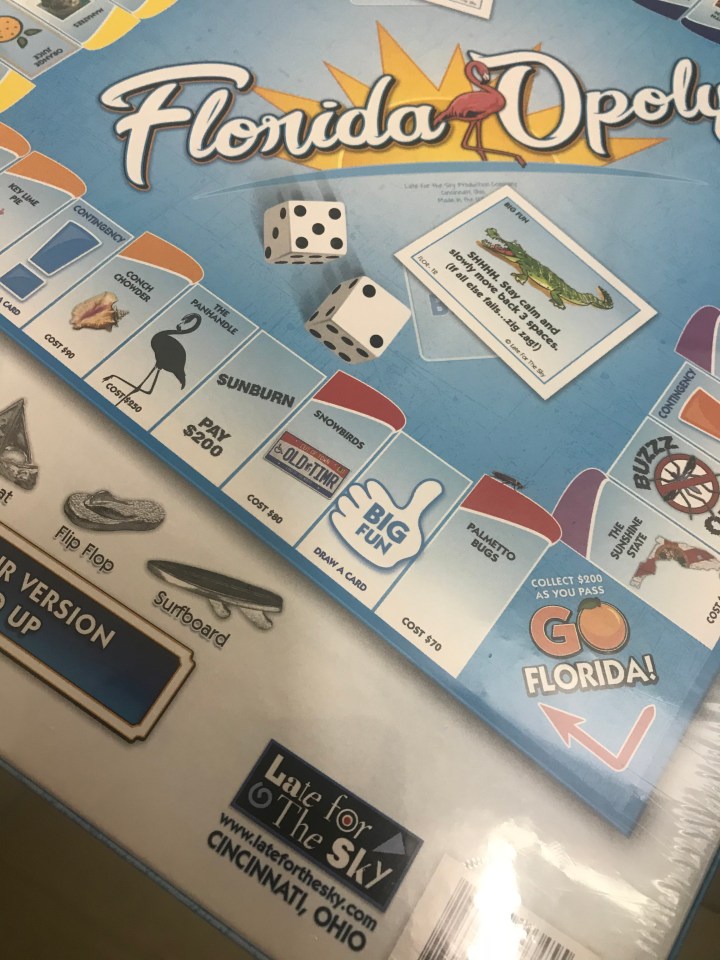 I was so honored to be presented with the newest wave of personalized Monopoly game, Florida-Opoly, last night by the Central Florida/Orlando cohort of 3D Leadership. For the guy that teaches leadership through the metaphors of toys, this was very appropriate and appreciated. When presented the game it was said they picked it as a gift of appreciation because I love to have fun, see the value of playing games, and have strived to learn all I can about Florida while spending time in the area. All true!
By personalizing the Monopoly game to local places, the creator, Late For The Sky, believes it brings more fun to the game through local authenticity. As a believer in local and state autonomy, this custom-opoly board game really struck a cord with me as I opened the box and began to explore all the parts, rules, and possibilities.
Here’s a brief rundown on what I found:
- Palm Trees
- Sunglasses
- Sea Turtles
- Sailboats
- Flip Flops
- Surfboards
- Key Lime Pie
- Alligators
- Orange Juice
- Disney World
- Snowbirds
- Manatees
- Dolphins
- Flamingos
- Hurricanes
- Sunscreen
- Atlantic Ocean
- Gulf of Mexico
- Conch Chowder
- Cuban Sandwiches
Now that’s a game. Players can buy their favorite Florida properties, like beach houses and resorts. But you have to watch out for hurricane warnings, alligators, and run ins with stingrays. Basically, it is a fun way to experience The Sunshine State. Also, it was a reminder of how different Florida is from my home state of Indiana. Now, I could make you a list of 20 cool things in Indiana, but the lesson here is the reminder of the different contexts in which we live.
This game is an important reminder of the complexity of the theory of autonomy. In 1982, President Ronald Reagan proposed returning significant responsibilities to the state and local governments. My other hero, Patrick Henry would have cheered. The challenge with this rhetoric, for as much as I believe in it and believe it should always be contemplated, is that it is not as simple as it sounds. The question that remains still today is what powers should be local and yet not compromise national concerns. I so wish I would have been around for the Federalism and Anti-Federalism discussions with the founders. It’s obvious I would have been an Anti-Federalist, but clearly a balance is where we landed (and needed to land). And, it continues to be a balancing act to this day.
As James Bryce posited in The American Commonwealth, “The wisest statesman is he who holds the balance between liberty and order” (Bryce, 1888, p. 749). Bryce spoke a lot about the balance of state’s rights and federalism in his critique of our democratic system of government. Bryce also warned of “Ill-considered legislation, facility and excess of law-making, and inconstancy and mutability in the laws, form the greatest blemish in the character and genius of our governments” (Bryce, 1888, p. 750). From a state’s rights standpoint, Bryce was concerned with states conducting rash experiments.
Alexis de Tocqueville did a much more sophisticated analysis of the underpinnings of a successful democracy. In Democracy In America (appearing in two volumes in 1835 and 1845), posited that there were two important tracks to our system, one of which were the broad freedoms assured by our national constitution. The other was a complimentary track of secondary liberties at the state and local levels. Tocqueville saw this as being product of human wisdom and choice, not historical necessity. Tocqueville saw the genius in a balance of both national and state/local control. Here we are at the end of 2019 still grappling the question of what the ideal balance is. Maybe that means our system works.
Only I could take the fun game of Florida-Opoly and turn in into such a deep political analysis. But, having spent Monday and Tuesday of this week up in Gary, Indiana to sort out best solutions for a school situation that I, as an Indiana State Board of Education member, have responsibility for, I can tell you the local, state, and federal contexts are at play. Full local autonomy failed our children, but some might argue that state and federal laws and requirements might have played a factor. Again, I believe it is a balancing act.
What I am for sure reminded of by Florida-Opoly is that we need to be aware of our local strengths, weaknesses, and needs. We then need to work within the autonomy we have to make our states and local communities great!
It’s All Superlatives
 Have you noticed that we talk a lot in superlatives? Almost to the point that the superlatives don’t mean much. Or, we even use them incorrectly by saying something to one individual in a group we are in like, “You’re the best!” We have just told everyone else they are not the best. Using superlatives has become an important part of negotiating and making a case, but have we done this at the expense of good?
Are we beginning to see “good” as anything very good at all? Sometimes it seems that “premium” has become our new “basic.” It’s our starting point, so “good” becomes “less-than.” It is amazing what adding “est” to the end of a word can do. On the user side of superlatives, we can take advantage of the stronger meaning. But, as a leader we have to watch getting hoodwinked. In other words, have we, in many cases, made an objective comparison impossible?
As I understand it, there are web advertising platforms that won’t allow the use of superlatives unless there has been a third party evaluator confirm that something is the “world’s best” or “extremest.” These providers don’t want advertisers making claims that are demonstrably false. The Merriam-Webster Dictionary tells us that superlative means “surpassing all others – supreme.” Leaders need to care about and practice the quality, specificity, and power of our language.
If we use superlatives too much, we wash out the meaning. If we make every commonplace event out to be extraordinary, we actually make everything sound the same. So, we need to be careful that “awesome” continues to mean awe inspiring and “best” keeps its superlative meaning and doesn’t just become “good.”
Is It Fun Being You?
 I didn’t really set out to do a blog series on thoughts following Boston Legal episodes, but it seems I am doing that because this will be my third such post. I’m telling you, those end of episode scenes of Denny Crane and Alan Shore sitting on the balcony discussing their lives, politics, cases, and their day are riveting and very thought provoking. My other two posts are: Are We Best Friends?; and Do You Have An Inexhaustible Ability To Just Live? The scene I am blogging about here was at the end of Episode 7 in Season 2.
Denny Crane says, “It’s fun being me. Is it fun being you?” Alan replies, “Most of the time actually.” To this, Denny reacts, “Then what else is there?” With a nod, Alan says, “Indeed.” I had never really contemplated the question of whether it was fun to be me before. My answer is, yes!And, indeed, there really isn’t anything else.
“Be who you are and say what you feel BECAUSE those who mind don’t matter and those who matter DON’T MIND!” ~ Dr. Seuss
It really comes down to being who you are. I came across the cool sweatshirt pictured below with the saying Such Fun Being Me on it. The Miranda Shop is selling the sweatshirts and I love their description of the sweatshirt: “This is one of my most loved of the new products. It gives me no greater pleasure than to think that people are able to become more and more happy and free in their own skin, loving and accepting themselves to freely be who they are.” That pretty much says it all, don’t you think?
 I guess it is all about having purpose and passion in how we are living our life. And, I think those of us who can honestly answer that it is fun being us, would say we still approach life much like a child. So, what does that mean?
To truly be happy, I believe we must get in touch with our inner child. Children are always happy in the moment. They are their true natures; they’ve not been taught they have to fit in (socialized) yet. Watch a child and you will see how free they are and how little they care what other people think of them. Children are pure love and light. Unfortunately, we play roles to fit into our society and then we end up suppressing our true nature out of fear of what others think. Remember, when you find yourself feeling judged, this is the socialized you, not the real you. Maybe that’s why it’s fun to be me; I can still run a toy tractor across the floor making the best tractor sounds ever!
Become freer; play, have fun, and enjoy the moment. It’s fun being me. Is it fun being you?
Do You Have An Inexhaustible Ability To Just Live?
 Yesterday I blogged about a scene from an episode of Boston Legal that really caused me to think and reflect. You can read about it in Are We Best Friends. Please allow me to post about another balcony interaction of Denny Crane and Alan Shore at the end of another episode.
After asking Alan Shore what he had had for lunch, and telling him he had a steak sandwich with onion rings, Denny Crane said, “Alan, you know, one thing you sometimes forget is, no matter how hard your day, no matter how hard your choices, how complex your ethical decisions, you always get to choose what you have for lunch.” Alan Shore replied, “Daily, I’m amazed at your inexhaustible ability to just live.” Replying, Denny Crane said, “It’s either that or die.” This hit me like a ton of bricks. I believe I have an inexhaustible ability to just live, but just exactly what is that and can we, as leaders, help develop this in others?
Of course this prompted a study for me. What I found was, nothing. So, how do we develop or continue to have an inexhaustible ability to just live? I was actually reminded of a bible verse (John 10:10) where Jesus tells us we are supposed to have an abundant life. Realizing there is a difference here when using the word abundant, I began to think about what really allows us just to live. It turns out that picking what we want for lunch is a perfect example.
 It is about what Lolly Daskal taught in the great book, The Leadership Gap: What Gets Between You And Your Greatness. Daskal posited that focusing on using can, want, and will instead of could, should, and must empowers us to live in terms of our own goals and motivations – just like picking what we want for lunch. Think about it: when asked about lunch, we say, “I want…”
Typically, when we choose what we want for lunch it is very authentic. We, or at least I can speak for myself, have no problem having the courage to proclaim what we want for lunch. Why not live and lead on our own terms in other areas of our life as well? Daskal also taught us to have a kinder dialogue with ourselves and focus on leading from within. Could it be as easy as working toward can, want, and will? I think so!
Finally, I believe an inexhaustible ability to just live means to go after what you want without worrying about what others will think. It means continually reaching out for newer, richer, deeper, life changing experiences. So let’s go push the boundaries of ourselves mentally, spiritually, and intellectually for personal growth and the betterment of the world at large. Also, step back and just enjoy the ride that is the journey of our life.
Do you have an inexhaustible ability to just live?
Are We Best Friends?
 Do any of you remember the show Boston Legal? It was one of my favorites. The comedy-drama ran for five seasons from 2004-2008. The show focuses on the personal lives of the upscale lawyers and their cases of the law firm Crane, Poole, and Schmidt. Recently, when our cable was out and we could get no channels, my son and I were on the phone and he said, “Dad you know we have a SMART TV so you can watch episodes of some of your old time shows.” I have to admit that I didn’t know that. Then he explained how to get to the shows and that this is what leads to people doing what is called “bingeing.” I also have to admit, I did it – binge watched Boston Legal. It was great and there were so many things said in the show that made me think. So, of course I had to blog about it!
At the end of each episode there is always Denny Crane (William Shatner) and Alan Shore (James Spader) sitting on the balcony in cool white chairs, which are called Bubble Club Chairs – that you can buy, by the way, drinking bourbon and smoking cigars. The talk is funny, but very deep and meaningful. In Season 2, Episode 8 Denny says to Alan, “What I give to you, I do with no one else (speaking of their time on the balcony each night and ultimately about their friendship). I like to think that what you give to me you do with nobody else. Now that may sound silly to you. But, here’s what I think is silly, the idea that jealousy or fidelity is reserved for romance.” Alan replied, “…But gosh what I get from you Denny. People walk around today calling everyone their best friend. The term doesn’t have any real meaning anymore. Mere acquaintances are lavished with hugs and kisses upon a second or at most third meeting, birthday cards get passed around offices so everybody can scribble a snippet of sentimentality for a colleague they barely met, and everyone just loves everyone. As a result when you tell somebody you love them today, it isn’t much heard. I love you Denny, you are my best friend. I can’t imagine going through life without you as my best friend. I’m not going to kiss you however.” Like I said, some funniness to it, but also very deep.
What does it mean to be a friend, a best friend, or to love, I mean really love, someone today? Do those terms, as Alan Shore lamented, really have any meaning any more? I’m not sure they do. In fact the balcony seen at the end of this episode has caused me to really reflect on my own definitions of love and friends. I’ll bet you were recently passed a card and asked to sign it and you may have thought to yourself, “I really don’t know this person.” I’m not saying that giving birthday cards is bad, but have we become a society of trivializing friendship and love?
So, I ask the question that Alan asked; does the term “best friend” have any real meaning any more? I believe to be a best friend is a privilege not to be bestowed on everyone. Showing another human being that you care about them and that their happiness and presence in your life is important to you on a regular basis is, though it may seem obvious, is a fairly big commitment in practice.
Remember how much easier it was to have a best friend in high school or college? You were with them every day. I find it difficult to be a good friend. Life seems to have a way of inserting itself and does a pretty good job of prying us apart. I think of all the times I’ve said, “We’re going to get together.” But, then never do. I’m a little, actually a lot, envious of Denny and Alan being able to sit on the balcony every evening at the end of the work day and philosophize. The lesson that can be learned from studying the characters of Denny and Alan is that being a best friend involves compromise, trust, and a mutual growth that allows certain friends to last through the good, the bad, and the ugly.
Really, friendship is a peculiar type of love. There is no real binding commitment to the opposite person other than what you are willing to put into the relationship. I really do think the term “friend” doesn’t have as much real meaning anymore. How many times have you had someone start a conversation with, “As a friend, you need to know…”? Many times there is not the friendship to be making the observation. That’s why, as the person on the receiving end, it upsets us. Again, we learn from Denny and Alan that a true “best friendship” allows us to:
- Love you for you
- Listen to understand
- Be accepting
- Be genuine
- Appreciate the humor
Do you know and appreciate the value of your best friend?
 Byron's Babbles
leave a comment