1973 – KISS Leadership

Gene Simmons of KISS during pregame of Super Bowl XXXIII
Yesterday I wrote Part I of a two part post entitled 1973 – Dolphin Leadership. Click here to read that post. Today, with only a few hours until Super Bowl 50, I continue to reflect on 1973 with Part II – 1973 – KISS Leadership. Leave it to me to be different. While everyone else is writing blog posts about the leadership of Peyton Manning and Cam Newton, I’m writing posts about the Miami Dolphins and KISS. Make no mistake, there is a KISS connection to past Super Bowls. The pregame show for Super Bowl XXXIII between the Denver Broncos (see the connection to Super Bowl 50?) and the Atlanta Falcons on January 31, 1999 at Pro Player Stadium in Miami, Florida included a  performance by KISS, along with their trademark elaborate make up, costumes, and theatrical pyrotechnics. By the way, Denver won that game.
Today’s post is about why I am so thankful that 1973 brought Gene Simmons, Paul Stanley, and KISS into our stadiums, arenas, homes, and lives. KISS has sold over 100 million albums worldwide. I would argue, and trust me I have, KISS is one of, if not THE biggest, greatest, and most successful bands ever. Why else would the announcer say “You wanted the best, you got the best! The hottest band in the land… KISS!” This was audacious! This was one of the first lessons I learned from Gene, Paul, and KISS – lead with audacity, but back it up! Led by the marketing genius that is Gene Simmons, they continue to reach new audiences while engaging lifelong fans. Think about the lifelong fan piece – there are literally, thousands of people just like me who would defend KISS as the greatest rock and roll band ever. Gene Simmons may be best known as the fire-breathing, bass playing demon in one of the most influential rock bands in history, but he can also teach us a thing or two about leadership. If you have not followed the journey as closely as I have, I would recommend you reading, Me, Inc.: Build an Army of One, Unleash Your Inner Rock God, Win in Life and Business. We can also learn a great deal from what Paul Stanley has learned during his journey as well. I learned a great deal from reading his book, Face the Music: A Life Exposed. In fact, I am going to put these two books on my to read shelf to reread. There are many other books written by the members of KISS that I would recommend. I’ll let you Google and make those choices.


So, let’s discuss KISS Leadership:
- Gene Simmons and Paul Stanley are truly “Rock Stars” and great examples of leaders. They are key members of my personal Mount Rushmore from the era of my youth, which also includes, Don Shula, Ronald Reagan, and Patrick Henry. To give an example of the KISS leadership example, I go back to an interview in April, 2014 during a great town hall interview on XM RADIO 39 HairNation following their induction in the Rock and Roll Hall of Fame where Gene said that he and Paul were always needing to try new “trepidatious” ways to perform! That’s what great leaders do! I promptly tweeted this (I’ve included an image of the tweet in this post).
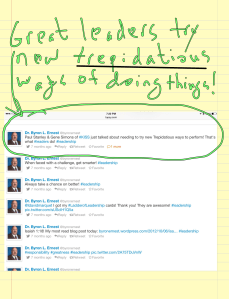 If you look up trepidatious you find the words: anxiety, anxious fear, and apprehension. So, that means they were being unorthodox, bold, and brave. Do you see the connection? Honestly, if you have not been to a KISS concert it will be hard for you to understand. Just suffice it to say, they are cutting edge. Heck, they redefine the edge…heck, there is no edge!
- In my blog post Language Matters, I wrote, “I still remember being inspired by the battle cry that the greatest rock and roll band ever, in my opinion, KISS, uses: “You wanted the best, you got the best. KISS!” Think about that – I wanted to go to the greatest rock show, and I always got it. Language Matters! But then we also know, we must then Walk the Talk!” Gene Simmons has taught us that the words we choose really do matter. Leaders must make the investment in time and energy and pay the price for choosing the right words based on the context and stakeholders. When we, as leaders, make this investment, the payoff is of “rock star” proportions. Choosing the right words will help us set up everyone we lead for a level of effectiveness that will bolster a culture of excellence and steady it against the winds of change.
- Gene Simmons teaches us that, “You have to understand that nothing appeals to everybody.” In other words you cannot be everything to everybody, but you must be the best you can be. Your content cannot be everything to everyone. KISS has always maintained a steady fan base by giving their fans what they wanted, and knew that they would never be able to please everyone. You are inevitably going to have critics; the important thing is to not let them derail your strategy. KISS has truly modeled for us how to be the greatest that you can be. There are none better at building a brand and trying bold and new ways to satisfy their customers.
- Paul Stanley taught us in his earlier mentioned book, Face the Music: A Life Exposed that, “No victories are won by individuals. The key to success is always teamwork.” Stanley learned that people coping with success need to surround themselves with people who have their best interests at heart. “Anyone who is pursuing success knows how lonely it can be and that having a support team or people who are blazing the path with you is very reassuring and gives you a shoulder to cry on and a team to celebrate with…” Paul Stanley also warns us to also beware of our own ego – I believe hubris could also come into play here as well.
- Gene Simmons taught us that we need to worry about imagery over content. In other words you don’t need to be the best or most qualified. Gene would tell us qualifications are highly overrated. There are thousands of people who had vision and leadership skills, who worked hard but didn’t have the exact skills to make their dreams reality.
 Think about it, Steve Jobs wasn’t a developer or a programmer, but as a leader he knew how to articulate a vision clearly with imagery. Leaders adapt the content to the audience, emphasize the vision’s intrinsic value, select words and symbols that are uplifting, and use language that is inclusive. If a leader is able to do these things, he or she will increase the chances that the vision will be embraced and the goal achieved. The real test is then implementation. As Gene Simmons says in his aforementioned book, Me, Inc.: Build an Army of One, Unleash Your Inner Rock God, Win in Life and Business, “There are many really stupid ideas that wind up being brilliant, if you can implement them.” Gene has shown us how to articulate the vision and then implement. Thus why thousands of us still consider ourselves part of the KISS Army.
- Continuing with the thought of implementation we must, as leaders, keep swinging the bat. We must not have a fear of failure, but a desire to try enough to fail and learn. In Me, Inc. Gene also teaches us, “Don’t let the fear of failure keep you from trying in the first place. Most baseball swings sound like this: ‘Swoosh.’ But, if you swing enough, you will hit some of the balls.” Enough said!
- Edge starts with self. Finally, I am reminded of an interview that KISS had with Jay Leno. Leno asked Gene Simmons where KISS got their edge. Without hesitation, Gene answered, “Edge starts with self.” Wow, that was several years ago, but is a perfect anthem for how we as leaders need to be. Let’s say that again: “Edge starts with self!” That gives me goose bumps! We have to be the leader our organizations and teams need us to be. Ghandi said, “You must be the change you wish to see in the world.” I say, “We need to become the leaders we need in the world!” Wow, I kind of like that – sure hope
 someone quotes me!
1973 – Dolphin Leadership

As I sit here on February 6, 2016 just hours away from Super Bowl 50, I am reflecting back on what I consider to be a year of great significance, when champions and rock stars where born: 1973. I was 10 years old and loved all the things that all 10 year old boys loved: football and rock and roll music. Yep, even as a rural raised, farm kid I would come in and spin the vinyl (for the younger ones in the crowd that’s short for records). Even at that age I was hungry and looking for those who could lead teams and groups to champion status. Well, I certainly found the icons that year.
 So, what made that year, 1973, special? Two things that would change my life forever. The Miami Dolphins won the Super Bowl and the band KISS was formed by Gene Simmons and Paul Stanley. Quite a combination of examples for the the young Ernest boy, don’t you think. Let’s take a closer look at my reflection of these two champions of rock start proportion. I am going to do this in two posts. Today’s post about the Miami Dolphins, Bob Griese, and Don Shula and tomorrow’s post about Gene Simmons, Paul Stanley, and KISS.
First, let’s look at the Miami Dolphins. You have to remember that there were no Indianapolis Colts at that time to follow or be a fan of. Therefore I became a fan of the team who had one of my future Purdue Boilermakers (he led Purdue to its first Rose Bowl Game in 1967) Bob Griese, at quarterback and renowned leader and coach, Don Shula at the helm. The undefeated campaign also had notable players Earl Morrall, and Larry Csonka as part of the team. The 1972 Dolphins went 14–0 in the regular season and won all three post-season games, including Super Bowl VII against the Washington Redskins, to finish 17–0. Wow, what a season for the kid that had the Dolphin towels, bed sheets and bed spread, sweatshirts, sweatpants, posters on the wall, and probably Dolphin underwear. You get the idea; I was all in for the Miami Dolphins. Little did I know it, however, but I was getting a great leadership lesson.
Don’t forget, the Dolphins also remain the only NFL team to complete an entire season undefeated and untied from the opening game through the Super Bowl. Pretty amazing and kind of like winning a triple crown. Also, let’s not forget that during the 1972 season, Bob Griese’s ankle was broken in Week 5 as he was sacked by San Diego Chargers defensive tackle Ron East and defensive end Deacon Jones. He was replaced by veteran Earl Morrall for the rest of the regular season. Griese returned to the field as a substitute during the AFC Championship game versus the Pittsburgh Steelers and then started for Miami in Super Bowl VII. So, there’s a leadership lesson from Griese, teaching us to fight back after adversity.
 On Leadership, Bob Griese was known for his decision making ability and servant leader mentality. He was known as the “Thinking Man’s Quarterback,” was drafted by the American Football League’s (AFL) Miami Dolphins in 1967. Also, don’t forget Griese led the Dolphins to three consecutive Super Bowls, winning two of them. There are those that say no one in NFL history had such talent around him to compensate for an average throwing arm. As for those teammates around him; the 1972 Dolphins defensive unit, called the “No-Name Defense” because Miami’s impressive offense received much more publicity. The Miami Dolphin defense was the league’s best that year. It was led by linebacker Nick Buoniconti, end Bill Stanfill, tackle Manny Fernandez, and safeties Dick Anderson and Jake Scott don’t know about that, but isn’t that what great leader do; surround themselves with great team member to achieve great purpose? That’s great leadership, baby! He is a leader and was a class act on and off the field.The man is a winner and a success at everything he does, just like all Purdue alums should be. He was an ideal sports icon for a young Indiana youth to be looking up to.
 Now, let’s talk about Don Shula’s leadership. It was great to have a championship role-model coach growing up. Later I read the books by Shula The Winning Edge and Everyone’s a Coach. Even though these books were published in 1973 and 1995 respectively, I would suggest everyone read them. In fact I just put the back on my reading stack for a re-read. Shula has given us an incredible acronym to live, coach, and lead by: COACH.
COACH
Conviction-Driven: Never compromise your beliefs
Overlearning: Practice until it’s perfect
Audible-Ready: Know when to change
Consistency: Respond predictably to performance
Honesty-Based: Walk your talk


Don Shula made a career of turning individuals into a team. He understood acquiring the perfect player is not the only way to win. Finding players with value, now that’s the formula. He developed the skills of players and gave them roles to contribute to the long-term success of the team. One of my most valued possessions in my office is my Don Shula 17-0 signed helmet. It reminds me every day what I need to strive for as a leader and COACH (someday I would love to get Bob Griese to sign it, too). Honestly, what more could we want or expect out of ourselves as leaders? So as we lead our own championship teams to run toward a greater purpose, let us remember these great leaders that 1973 brought to stardom.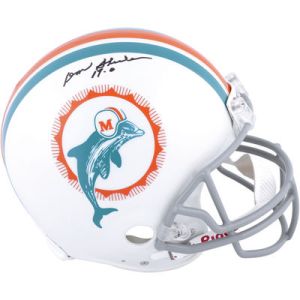
Tomorrow, my blog post will be entitled, 1973 – KISS Leadership. Find out about the other great leadership example born out of 1973.
Here and Now
 Contrary to popular belief, human beings cannot multitask. You just can’t effectively attend to two things at once – even the superficially automatic ones. So, how do we stay in the moment? The first thing to recognize is that, try as we might, we really can only do one thing at a time, so we ought to do that thing wholeheartedly. Sometimes that one thing is paying attention to those we lead. Really paying attention and listening to those we lead. Most of our time is spent in the past or the future, rather than the present moment. What we end up doing is passing through the here and now on the way to somewhere else and, in doing so, we miss the moment. Sometimes these are important moments with our team members, whether in individual conversations or group meetings.
“…being in the moment with your team, those you must regularly influence in your leadership, will boost your ability to lead effectively and ultimately drive better results.” ~John M. Manning
Have you ever been speaking to someone and found that they are distracted by something and not really listening to you? You probably thought this was annoying, frustrating, and disrespectful. At that point you may have even become angry or shut the conversation down. In Lesson #22 of The Disciplined Leader (2015), John Manning taught us that great leaders are always fully engaged. When listening pay attention not only to the words but the tone of voice, facial expressions, and body language. This will give you information that will be as important as the words themselves. Most people are thinking of how they are going to reply when someone is talking. Instead of doing that, try to focus completely on what the person is saying.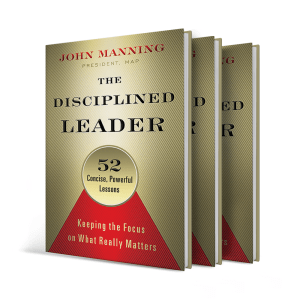
Active listening is one of the most-important things you will do as a leader. Turn off your computer and your phone, shut your office door, and truly listen to the employee that is expressing their concerns. You may want to make some notes during the meeting – I still take notes on a pad of paper. Furthermore, I am a believer in an open door policy. By keeping yours open as much as possible, you’ll help show your willingness to be part of the team—not above it.

A closed door not only muffles the communication on both sides, but it blinds a manager to the general vibe and energy of the group. Leaders are expected to lead, mentor, and support—things that become pretty tough to accomplish when your employees are afraid they’ll bother you with questions – they will feel this way if the door is always closed. There will obviously be times when a closed door is necessary. I’m a believer it is perfectly acceptable to close your door if necessary to get some things done. But use that perk sparingly and you’ll help cultivate a more collaborative and respectful environment in the office. Not to mention, help give some credibility to that open door policy we’ve all heard so much about.
The bottom line is we need to eliminate distractions and not just show that we on engaged, but be engaged!
References
Manning, John (2015). The disciplined leader: Keeping the focus on what really matters. Berrett-Koehler Publishers. Kindle Edition
Managing Strategies for Engagement

This post is an excerpt from the book Authentic Conversations by James Showkeir and Maren Shokeir. This book is included in BKpedia, a new digital subscription service from Berrett-Koehler Publishers. Please visit bkpedia.bkconnection.com for graphics, tweets, and other resources.
Managing Strategies for Engagement
Engagement means being able to make meaningful decisions and to have the resources to act on those decisions.
The marketplace demands results now. Your customers want attention in this moment. The necessity for flexibility and speed in the face of change is paramount. The question is how to create an organization that can:
• Quickly create and apply new knowledge
• Grant exceptions and deliver unique responses
• Foster passion and accountability throughout the entire enterprise
For these significant changes to occur, three areas in the organization must be affected: (1) culture and management/governance practices, (2) architecture, which includes the ways jobs are designed and how people are grouped, and (3) the ways in which employees are rewarded. For all these changes to be planted and take root, new conversations are required.
Individuals must accept personal accountability for the success of the whole business and be responsible for their own motivation and morale. The culture must generate passion for the work and action in service of customers and good results. This requires less focus on personal ambition and a sincere commitment to the success of others.
Organizations have to create and sustain universal business literacy and adult-to-adult conversations, one person at a time. Management practices, such as budgeting, meetings, training, objective setting, performance reviews, and so on, must be recreated to encourage partnership. Dissent must be viewed as healthy. Through different conversations, knowledge and collaboration are baked into the work process, replacing compliance and control as the operating values.
Where to start? If the longest journey begins with a single step, it won’t surprise you that our advice is to begin by changing the conversations. Better conversations will reap rich, diverse information. They will encourage an examination of who plays key roles in improving business results. They will allow you to address difficult issues in a constructive way.
New conversations will champion the kind of learning and resourcefulness that lead to innovation, cost efficiency, and personal accountability—essential elements in addressing the complex problems of organizational renovation.
*****
James Showkeir and Maren Showkeir are principals of Henning-Showkeir & Associates, Inc., whose clients include 3M, Ford Motor Company, Kaiser Permanente, British Airways, Coca-Cola, Hewlett-Packard, Levi Strauss, the Greenleaf Center for Servant-Leadership, and the Nature Conservancy. Together they authored Authentic Conversations and Yoga Wisdom at Work. James passed away in August of 2015.
Compelling Purpose
 It was such an honor to support the launch of the 10-year anniversary edition of The Serving Leader. I love having the opportunity to collaborate with Becky Robinson and all the great individuals at Weaving Influence. Being part of their launch teams has enabled me to grow personally as a leader and hopefully provide valuable information about potential books for other leaders to read, both through my blog posts and Tweets.
I am particularly glad I had the opportunity to read The Serving Leader, not only because it is a great book, but also because it really hit home with some things I am experiencing first hand right now as a school leader. I love the way the book has provided us with ways to navigate so many of the real-life challenges and opportunities that face leaders every day. By reading and reflecting on the book, I was able to put myself in those situations or go back and think about past experiences and think through the proper way to respond. The key word here is “respond,” instead of reacting. The book gives lessons on Five Powerful Actions:
- Run to Great Purpose
- Upend the Pyramid
- Raise the Bar
- Blaze the Trail
- Build on Strength
 For this post, I want to focus on “running to a great purpose” and “building on strengths.” I believe Kenneth Jennings and John Stahl-Wert (2016) got it right when they said, “Failing to provide workers with a link between their daily tasks and a great and compelling purpose is tantamount to managerial malpractice (p. 137).” It is possible for everyone in an organization and even the stakeholders supporting the organization to run toward a greater purpose. As a school leader of turnaround schools that have been in need of cultural, operational, and academic changes I have learned that the team needs a compelling purpose. For us, this has become being a “Real School” and “Students First.” Think about it…doesn’t every student deserve a “real school” and to be put at the top of the priority list.
This book really reinforced the idea that part of being a serving leader is to create and cultivate an exciting fully engaged workforce. We all know that workforce engagement, or the idea that we all believe that what we are doing makes a difference for the organization we work for and the people we serve. To that end it is very important that every individual understands his/her role in carrying out the purpose of the organization. We must, as is pointed out in the book, recognize that those we lead are looking to us to help them understand why the role he/she is playing is crucial to carrying out the great purpose.
I’m really proud of how we have been running toward a great purpose as a school. Through our Focused Leader Academy, becoming a learning organization, and making decisions in a collaborative fashion we are building on the strengths of our staff, which is becoming very engaged. Our teachers do understand the difference they are making in the world. Every day I see more of our teachers stepping up into teacher leadership roles. I would like to share a couple of comments written by a teachers applying to be part of our School Improvement Team. I believe that our vision is being translated into every daily work assignment (Jennings & Stahl-Wert, 2016). Here are the comments:
“As a school, our primary focus is upholding the expectation that all students will achieve academically. As educators, we strive to close the achievement gap between our low-performing students and their more average achieving peers. My commitment to school-wide change and my understanding of how to apply the collective knowledge of my colleagues in order to improve teaching and learning in my course has prompted me to apply for this excellent opportunity”
“…I have seen the school grow by leaps and bounds into something quite brilliant. I want to see the program continue to grow and evolve with the needs of our students, families, and staff. A school like ours is desperately needed by so many across the state. It would truly be a huge disservice if we simply dug our heals in and continued to just “do what we’ve always done.” We must keep our machine well-oiled, maintained, and on the cutting edge and the only way to accomplish that is to make improvements along the way.”
As you can see we are making progress toward a culture of excellence where our staff is becoming engaged in true contribution. By encouraging risk and encouraging failing forward our staff is excited to take on new and challenging leadership assignments with the goal of carrying out our compelling purpose.
Reference
Jennings, K. R. & Stahl-Wert, J. (2016). The serving leader: five powerful actions to transform your team, business, and community. Oakland, CA: Berrett-Koehler Publishers, Inc.
 Byron's Babbles
leave a comment